Key Takeaways
- OUSD launched Sept. 30 with more than $1 billion committed by five founding partners.
- Tempo reported over $400 million in OUSD liquidity on its first day.
- Open Standard gives OUSD partners reserve yield as it takes on USDT and USDC.
Stripe-Backed OUSD Lands With $1 Billion and a Different Stablecoin Bet
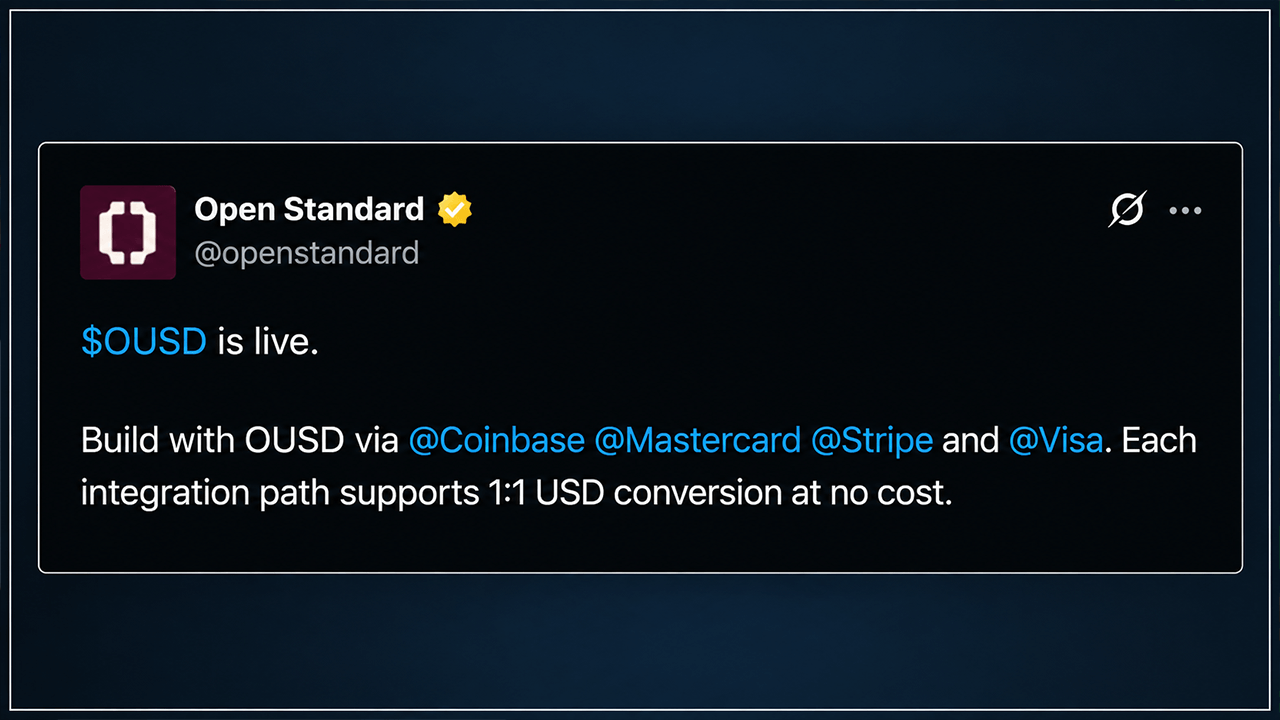
Fiat-pegged stablecoins have long offered issuers a handsome business: collect dollars, issue tokens, and earn income on the reserves. Open Standard’s open usd (OUSD) stablecoin is trying to turn that arrangement inside out. The U.S. dollar-pegged token went live Wednesday with more than $1 billion committed by founding partners Coinbase, Mastercard, Shopify, Stripe, and Visa.
Businesses that clear know-your-business checks can mint or redeem OUSD at par, without fees or volume caps, while partners receive most of the reserve income. In other words, OUSD isn’t merely chasing USDT and USDC for circulation. It’s taking a crack at who gets paid for putting those dollars into circulation.
Open Standard first took the wraps off the project on June 30 with more than 140 companies committed. By Wednesday, that roster had climbed above 200, covering banks, card networks, fintech firms, commerce platforms, and crypto infrastructure providers. Coinbase, Mastercard, Shopify, Stripe, and Visa hold equal initial equity stakes, while much of the remaining ownership is intended for partners that actually increase OUSD supply and transaction volume over the coming years.
The machinery is fairly straightforward. OUSD is backed 1:1 by U.S. dollars, with reserves held at financial institutions like Blackrock, Lead Bank, and BNY. Bridge, which Stripe bought for $1.1 billion in 2024, issues the token and publishes monthly reserve attestations. Open Standard keeps a small management fee, while partners collect the rest of the reserve yield. That flips a familiar stablecoin business model, where the issuer typically hangs on to the income generated by the float.
“We want to be the most useful stablecoin, the same way the U.S. dollar is useful. Every other stablecoin is building a fund. We’re building money,” CEO Zach Abrams said.
Four Chains, No Bridged Copies
OUSD went live natively on blockchain networks such as Ethereum, the Coinbase-incubated Layer 2 network Base, Solana, and Stripe-aligned Tempo, meaning there isn’t one original token with bridged copies scattered around. Each network gets a native version. Access initially runs through Stripe, Mastercard-owned BVNK, and the Visa Stablecoin Platform, while Coinbase support begins Oct. 1. Coinbase, Kraken, and Uniswap are the first exchange venues.
Tempo supplied the first eye-popping number. The network reported more than $400 million in OUSD liquidity on day one, and Tempo Chief Business Officer Dan Romero explained that the chain is aiming for roughly $1 billion within a few months. Aave Labs has also filed a proposal to add OUSD as a supply-and-borrow asset on Aave V3 Core and V4 Core Hub, although not initially as collateral.
The Heavyweights Are Already at the Table
The partner sheet reads less like a crypto startup roster and more like a payments convention. Visa, Mastercard, American Express, Discover, Blackrock, BNY, Standard Chartered, U.S. Bank, Google, Shopify, Coinbase, Ripple, Western Union, and others are involved. UBS and Japan’s SBI Holdings later joined. USDC issuer Circle, notably, isn’t a partner.
Stripe’s Will Gaybrick said OUSD will become Stripe’s default stablecoin for businesses, while executives from Visa, Mastercard, and Coinbase have stressed that they remain committed to supporting multiple coins rather than replacing USDC.
While Circle’s stock was initially hit when Open Standard first revealed the project, today, the news didn’t do much for the USDC issuer’s shares. However, CRCL, traded on the New York Stock Exchange (NYSE), is down 10% over the last five trading sessions and about 38% lower over the last 12 months. Wednesday’s trading session showed CRCL trading down slightly by mid-day.
The Billion-Dollar Question
For all the marquee names, Open Standard doesn’t escape the old stablecoin problem. Distribution is everything. Bridge retains upgrade, pause, freeze, and allowlist powers, while the five founding companies control the early equity. Partners must also meet undisclosed activity thresholds to earn ownership.
And USDT and USDC already have something OUSD cannot manufacture overnight: entrenched liquidity across major trading venues. The newcomers have put a tidy sum on the table, but $1 billion in commitments and $400 million on Tempo now have to turn into actual circulation. A stablecoin backed by some of the biggest names in payments has arrived. The interesting part will be seeing whether those companies and their customers will actually use it.