Key Takeaways
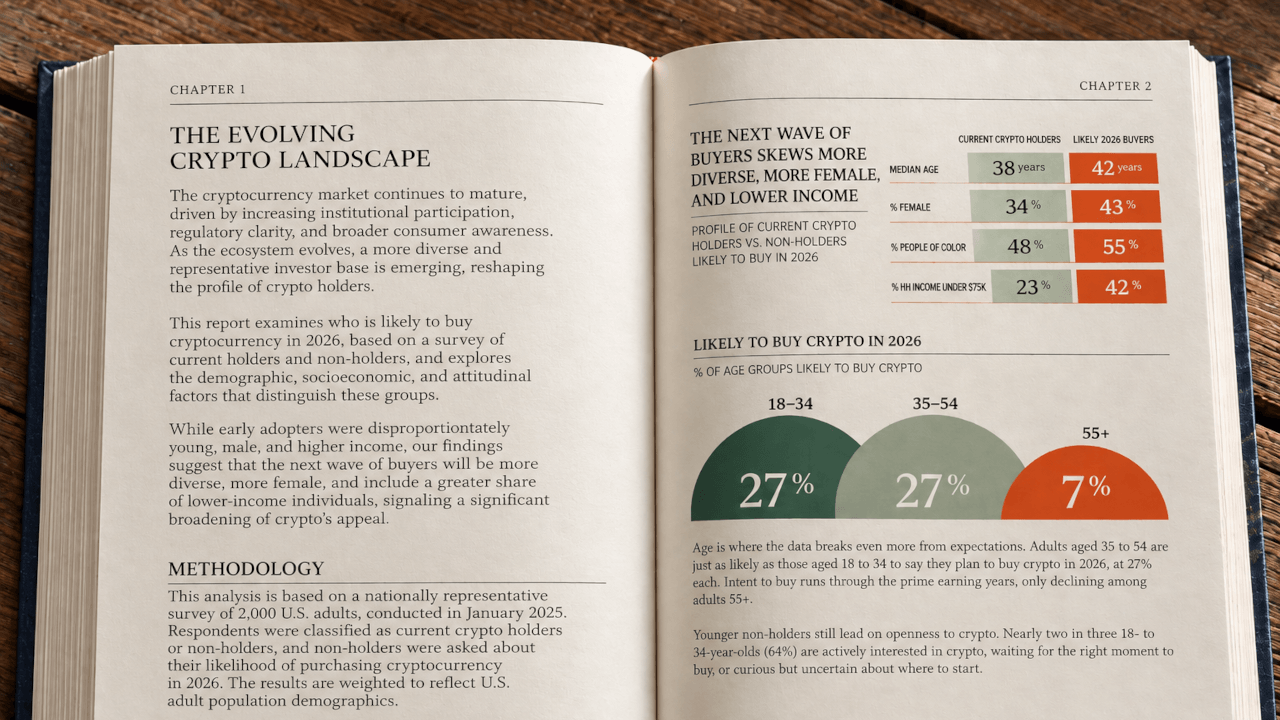
- Likely buyers have a median age of 42, compared with 38 for holders.
- Women represent 43% of likely purchasers versus 34% of current owners.
- Households earning under $75,000 make up 42% of likely buyers.
Potential Buyers Look Different From Current Crypto Holders
More than 33 million Americans without cryptocurrency holdings are likely to buy in 2026, according to research released Oct. 6. The Harris Poll conducted the study for the National Cryptocurrency Association (NCA), a nonprofit focused on crypto education. Its crypto readiness findings describe nonholders who considered themselves somewhat or very likely to purchase in 2026.
The potential buyer population had a median age of 42, compared with 38 for current owners. Women represented 43% of likely purchasers versus 34% of holders, and households earning under $75,000 accounted for 42% of potential buyers versus 23% for existing crypto holders.
Adults ages 35 to 54 were just as likely as those ages 18 to 34 to anticipate buying crypto, at 27% each. The figure fell to 7% among adults 55 and older. People of color represented 55% of likely buyers, compared with 48% of current holders.
The Harris Poll surveyed 2,014 U.S. nonholders online June 24-July 1, with demographic weighting to reflect the population. The study reported sampling precision of plus or minus 2.1 percentage points at a 95% confidence level.
Separate NCA research earlier this year estimated that more than 67 million Americans hold crypto, following an increase of 12 million holders in one year. The readiness study examines intentions among people who held no cryptocurrency when surveyed.
Confusion Creates a Larger Barrier Than Market Volatility
Lack of understanding ranked ahead of other ownership barriers at 48% when respondents selected their three main reasons for not owning crypto. Security and fraud concerns followed at 43%, while market volatility drew 26%. Among changes that could make buying more comfortable, clearer information led at 26%, closely followed by better scam protection at 25%.
Among Americans who do not own crypto, 41% of those who felt knowledgeable about buying it were likely to purchase in 2026, compared with 11% of those who felt not at all knowledgeable about buying crypto. Separate household research from the Federal Reserve Bank of Cleveland also identified a bitcoin knowledge gap.
The Cleveland Fed working paper, published July 14, tested how information influenced investment decisions. Its authors observed increased desired holdings and subsequent purchases after participants received information about historical cryptocurrency returns.
Among Americans likely to buy crypto in 2026, 41% cited diversifying their investments as a reason, making it the most common motivation. Other reasons for exploring how cryptocurrency works included buying goods and services (26%), receiving payments faster (24%), and accessing their money at any time (24%).
Trust and Education Shape Whether Intent Becomes Ownership
More than one-third of non-holders indicated they would be more likely to buy cryptocurrency through a trusted financial institution. That preference connects with financial institutions expanding bitcoin services, including trading, custody, and investment products. Among non-holders with advisers, 66% indicated an advisor’s recommendation would increase their likelihood of buying, while 76% would become more likely to learn. However, 61% had never discussed crypto with their advisor.
Women reported less familiarity with buying crypto than men, with 16% describing themselves as knowledgeable compared with 39%. Across all non-holders, 59% of respondents were open to crypto, including skeptics willing to consider it. The NCA summarized their needs:
“Non-holders want clearer information, better protection, and trusted voices leading the way.”
That openness extended even to respondents who generally avoided crypto when the survey posed a hypothetical gift worth $1,000. Only 12% of all non-holders would refuse it outright, compared with 26% of active avoiders. Across the full sample, 41% would hold the gift and watch its value, 15% would invest further, and 12% would spend it or make payments.