Key Takeaways
- Liron Shapira gave 50% odds on Sept. 6 that AI breaks Bitcoin’s security and BTC falls 50%+ within two years.
- Buterin replied Sept. 7 that a SHA-256 or proof-of-work break is a “tiny” risk and BTC can patch the rest.
- BTC trades near $80,000 after a Sept. 3 high of $82,239, so the call needs a print under $40,000 by 2028.
The Wager on the Table
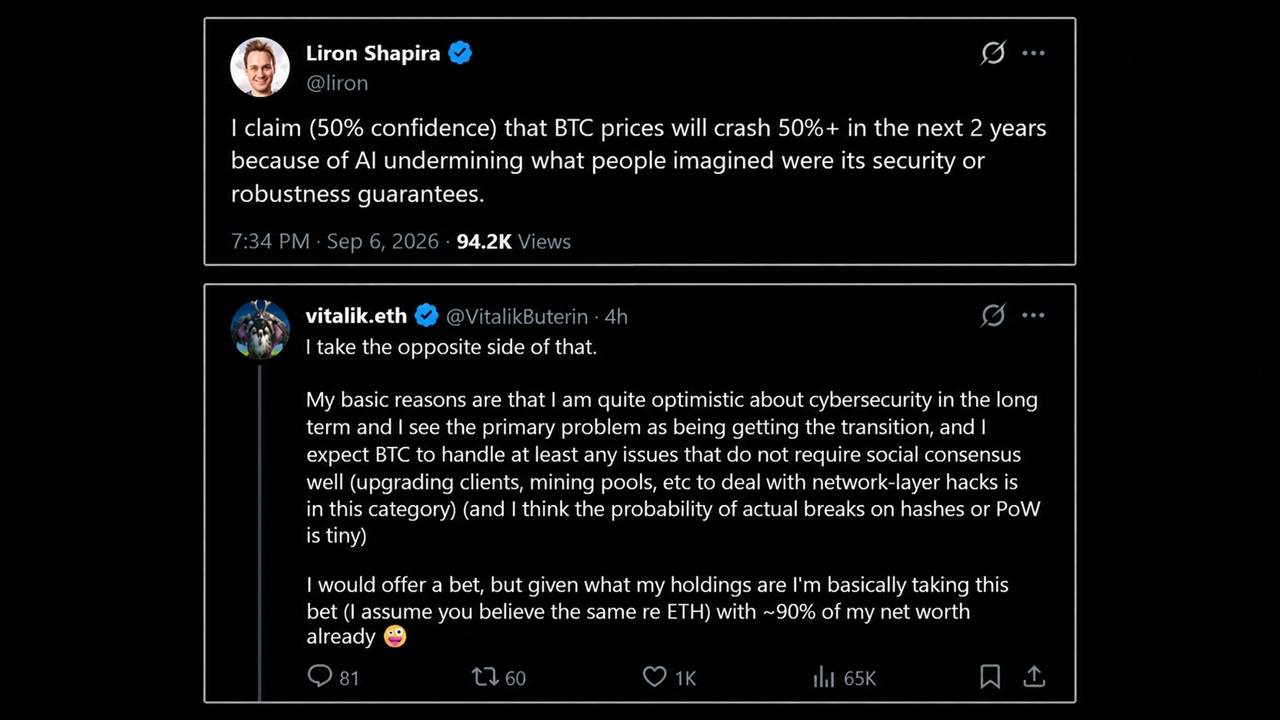
Liron Shapira, an angel investor who hosts the Doom Debates podcast and debated Buterin on AI risk last year, posted his claim yesterday, stating:
I claim (50% confidence) that BTC prices will crash 50%+ in the next 2 years because of AI undermining what people imagined were its security or robustness guarantees.
Buterin’s answer landed about half a day later, where he noted he takes “the opposite side of that (stance).” His reasons were that he is “quite optimistic about cybersecurity in the long term,” and sees “the primary problem as being getting the transition. Moreover, he expects “BTC to handle at least any issues that do not require social consensus well.” Upgrading clients and mining pools to deal with network-layer hacks falls into that category, he said, while “the probability of actual breaks on hashes or PoW is tiny.” He closed out by saying:
I would offer a bet, but given what my holdings are, I’m basically taking this bet (I assume you believe the same re ETH) with ~90% of my net worth already.
The Bet From Each Side
Shapira’s claim is about perception as much as code. His phrasing targets “what people imagined were” bitcoin’s guarantees, meaning the market could re-price BTC on fear of an AI-found flaw well before any flaw is exploited. On that reading, a 50% drawdown only needs a loss of confidence, not a broken hash function.
Buterin’s answer, however, is more of an engineer’s, splitting the risk into two buckets:
- Bugs in client software
- Mining-pool infrastructure and the peer-to-peer layer, which developers and node operators can patch without changing Bitcoin’s rules.
A genuine break of SHA-256 or proof-of-work (PoW) would require a hard fork and social consensus, and he puts that in the “tiny” bucket.
In a separate thread the same night, he pointed to the speed at which new tricks for succinct proofs (SNARKs) and fully homomorphic encryption (FHE) have arrived “particularly in 2026.”
He argued that “hard problems are abundant,” so cryptography keeps finding new footing as old assumptions erode. Ethereum’s own roadmap, overhauled on Aug. 10, moved quantum safety to the top of the list for the same reason.
The Fine Print
Buterin’s “90%” is not a fresh position but rather a statement that his existing holdings, most of them ETH, already lose if AI breaks the cryptographic assumptions both networks share. His parenthetical to Shapira, “I assume you believe the same re ETH,” makes the point, i.e. a hash-level attack would not stop at Bitcoin.
As things stand, bitcoin’s price sits near $80,000, after hitting a three-month high of $82,239 last week and stalling below an $80,335 to $82,239 resistance band over the weekend.
Whales are not positioned for it, as wallets holding 100 BTC or more added about 60,000 BTC in August, per Cryptoquant, buying almost exactly what smaller wallets sold.