Key Takeaways
- Near Intents detected over $50M in laundering attempts tied to Bitget’s Sept. 24 hack.
- SHIELD froze $503,000 during execution, while just $166,000 passed through Near Intents.
- Bitget CEO Gracy Chen praised Near Intents for waiving its recovery bounty.
Hackers Run Into a $50 Million Roadblock
The hackers behind Bitget’s nearly $388 million security breach found themselves facing an unexpected roadblock when they attempted to funnel stolen cryptocurrency through Near Intents. Rather than provide an easy escape route, the cross-chain protocol’s security system identified more than $50 million in suspicious flows, stopped transactions and froze over half a million dollars’ worth of crypto during execution.
The response drew applause from Bitget’s CEO, who has been calling on decentralized protocols like Thorchain to prevent known stolen assets from moving through their infrastructure. And the outfit responsible for the $50 million intervention isn’t asking for a penny in recovery rewards.
SHIELD Catches Hackers Trying to Move Stolen Funds
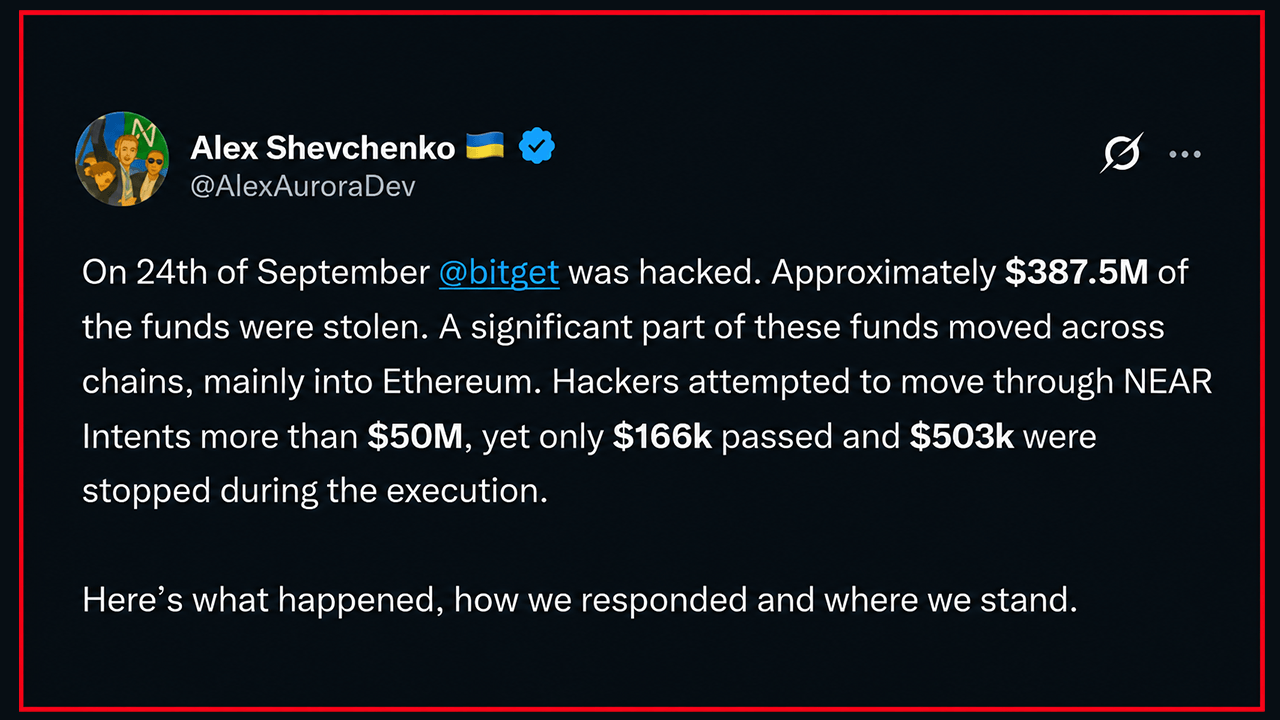
On Sept. 28, Ukrainian blockchain engineer and Aurora co-founder Alex Shevchenko took the wraps off Near Intents’ response to the Sept. 24 Bitget breach, which resulted in approximately $387.5 million being stolen.
Shevchenko explained that much of the cryptocurrency moving through cross-chain services eventually converged on Ethereum as ETH. The attackers also attempted to route more than $50 million through Near Intents, a protocol that routinely handles over $100 million in daily cross-chain trading volume. Their efforts ran into SHIELD, Near Intents’ automated risk-intelligence layer.
The system monitors transaction patterns and collects information from blockchain intelligence firms, know-your-transaction (KYT) providers, independent researchers and industry participants. When suspicious activity surfaces, SHIELD can decline to provide transaction quotes or halt transfers already underway.
In this case, SHIELD identified more than $50 million in attempted laundering flows, with duplicate transactions filtered out. Approximately $166,000 made it through, while another $503,000 was frozen during execution. Shevchenko cautioned that the figures are rounded estimates, with potential attribution errors of up to 10%.
Bitget CEO Applauds Intervention as Protocol Waives Bounty
There was another twist. Near Intents announced it would waive its share of Bitget’s recovery bounty, leaving more money available for the exchange to recover.
Bitget CEO Gracy Chen welcomed the intervention, posting the following response to Shevchenko:
“Appreciate Near Intents / SHIELD for stepping up on the Bitget incident: flagged $50M+ in attempted laundering flows, froze $503k mid-execution, and waived their own bounty share so we can recover more. This is what permissionless but not ‘facilitating known stolen funds’ should look like. A public chain doesn’t have to choose between being open and excluding hackers, you can build the risk detection in and still let anyone use the chain. More protocols should take notes.”
Chen said she would follow up with the appropriate legal and recovery process and thanked the Near Intents team. “This matters a lot, to Bitget and to our industry,” she added. The frozen $503,000 remains restricted pending appropriate legal and recovery proceedings. Near Intents has directed Bitget to pursue those funds through established legal and law enforcement channels.
Permissionless Doesn’t Mean Helping Thieves, Shevchenko Says
The intervention also enters a broader industry argument over whether decentralized infrastructure should restrict transactions associated with stolen cryptocurrency. Shevchenko’s position is that building permissionless systems doesn’t require their operators to facilitate the laundering of stolen property.
He also sounded the alarm for wallet providers, arguing that integrations with questionable liquidity sources can expose both operators and users to legal, regulatory and reputational consequences. His closing argument was straightforward: Near Intents intends to remain permissionless infrastructure while actively opposing the laundering of hacked funds.
For Bitget, the immediate result is $503,000 frozen and a recovery partner declining its bounty. For the hackers, a protocol processing more than $100 million daily has effectively told them to take their stolen business elsewhere.