Key Takeaways
- XRP long liquidations on Binance exceed short liquidations.
- The network value-to-transactions ratio fell 69.28% to 36.97.
- U.S. spot XRP ETFs recorded $3.28 million in outflows on Oct. 2.
XRP Forced Selling Eases After Repeated Liquidation Spikes
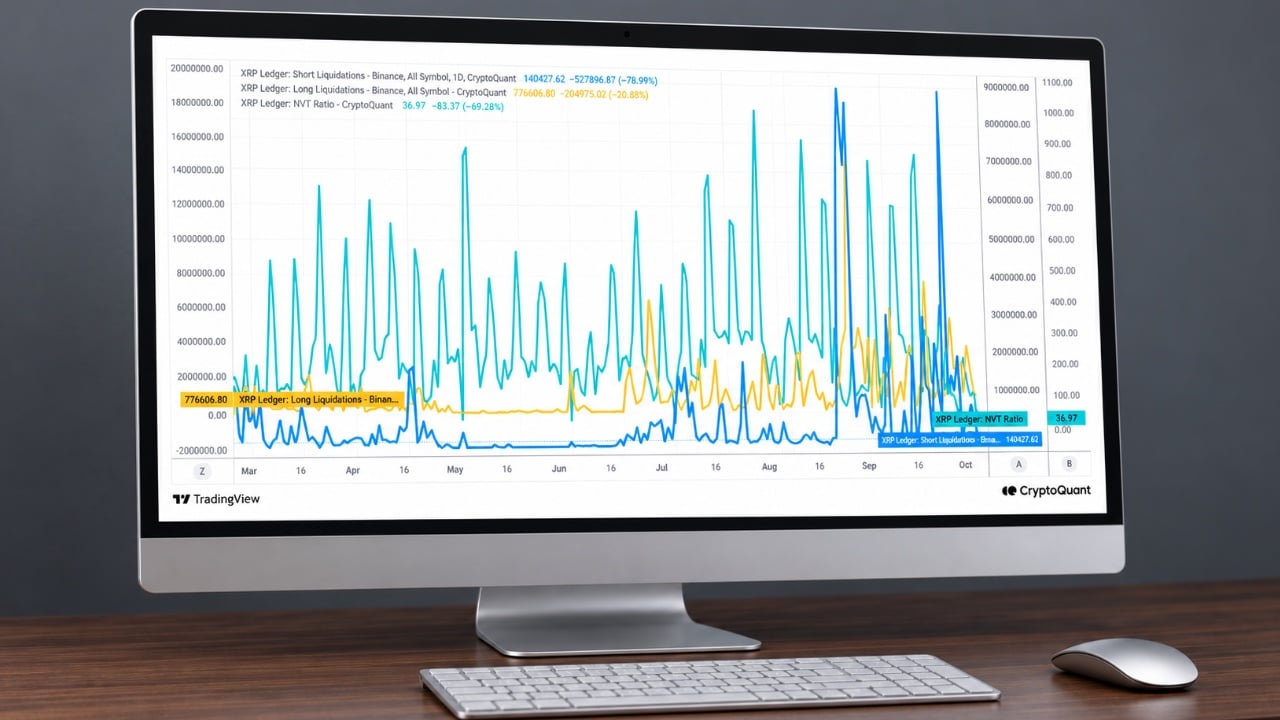
XRP traders on Binance are seeing fewer forced position closures after repeated liquidation spikes from late July through September, according to an analysis published by Cryptoquant on Oct. 2. Cryptoquant contributor “PelinayPA” examined easing XRP liquidation pressure using a chart combining exchange liquidations with a network valuation measure.
The shift follows a contraction in derivatives, contracts linked to the token’s price rather than direct ownership. Binance’s outstanding XRP derivatives positions contracted about 32% between Aug. 22 and Sept. 17, from roughly $323 million to $219 million. Known as open interest, this measure tracks exposure that remains open.
Leverage magnifies gains and losses by allowing investors to control trades larger than the collateral they deposit. Exchanges trigger forced closures of futures positions when those funds cannot meet margin requirements, the minimum needed to maintain a trade. Longs benefit from rising prices; shorts profit from declines.
The analyst described an imbalance in the latest readings that leaves traders positioned for further gains vulnerable:
“In the current data, long liquidations appear to be higher than short liquidations, suggesting that long positions have been more heavily affected by recent downward price movements.”
XRP Network Ratio Falls 69%, With Activity in Focus
Alongside the reduction in forced selling, XRP’s network value-to-transactions ratio, or NVT, declined 69.28% to 36.97 in the analysis. The measure compares market capitalization with onchain transaction volume expressed in dollars. These figures represent the total value of circulating tokens and transfers recorded on the blockchain, respectively.
A lower reading can reflect increased transfers, reduced valuation, or both, so the analyst’s interpretation depends on the underlying changes. If more value moved across the blockchain while NVT decreased, network usage may have strengthened relative to its market value, potentially supporting prices.
Network usage also drew attention during September’s advance, when blockchain analytics firm Santiment counted 1,917 large transactions and 3,647 new wallets as XRP rose above $1.60 on Sept. 22. Those tallies show activity rather than verified buying: Large transfers can represent sales or internal movements, and new addresses do not necessarily identify new investors.
Spot Buying Remains Central to Sustained XRP Gains
The distinction between blockchain transfers and purchases also applies to exchange activity, where spot buying involves acquiring XRP itself. By comparison, perpetual futures provide price exposure without an expiration date and can be traded with leverage on centralized exchanges or decentralized platforms that execute trades through blockchain software.
Fund flows offer another measure of XRP demand alongside leveraged trading. U.S. spot XRP exchange-traded funds (ETFs), which hold the asset and offer exposure through shares, recorded $121.4 million in September inflows. For Oct. 2, Sosovalue figures reported Oct. 3 showed $3.28 million in net outflows, all from Bitwise’s fund. The ETFs held combined net assets of $1.658 billion.
The analyst outlined the conditions for a lasting advance:
“If spot market demand also accompanies these developments, it could provide a stronger signal. The decline in liquidations may offer some relief; however, for a sustained rise, spot buying, trading volume, and price structure would need to support the move.”